
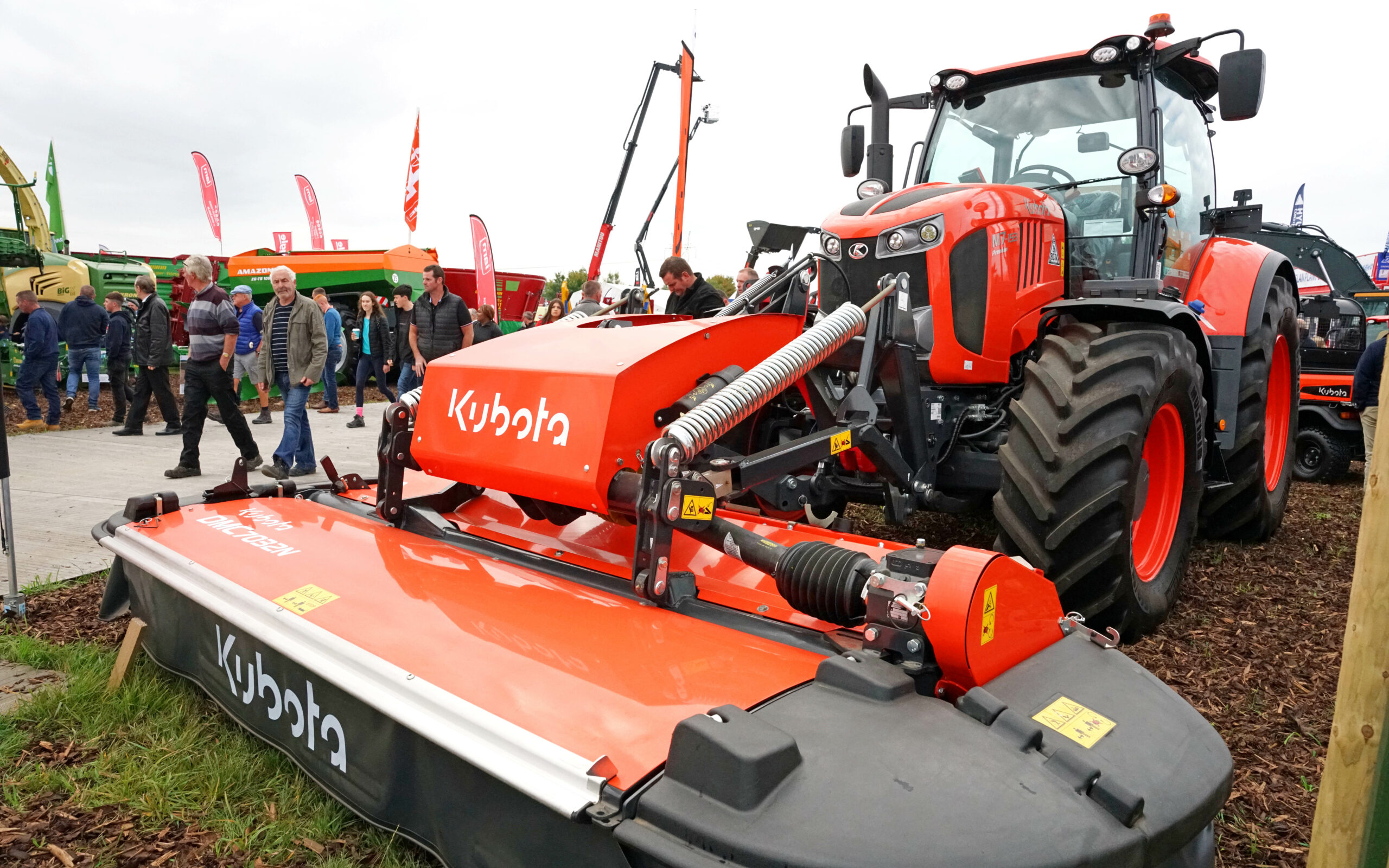

Over the last year or so the focus of tractor manufacturers has turned towards alternative fuels to power the well-proven compression ignition (CI) engine, and Kubota is the latest to join the movement with the news that all its new tractors are suited to running on hydrotreated vegetable oil (HVO).
The company has confirmed that it is possible for all of its new diesel-engine tractors to run on both HVO and GTL (gas to liquid) which, it indicates, will contribute to a lower carbon footprint for Kubota internal combustion engines.
HVO
The approval of these fuels follows Kubota’s internal evaluation of their effect on the performance of its units, and they have attained a clean bill of health.
The company has confirmed that any paraffinic fuel that complies with the European standard EN15940 is suitable for use across its range of diesel engines.

As a manufacturer of industrial engines, tractors, groundcare and construction equipment, Kubota recognises that HVO, which is synthesised from vegetable oil and fat, is likely to become increasingly popular due to its environmental benefits.
GTL meanwhile, is synthesised from natural gas, therefore its contribution to reducing total carbon emissions is somewhat less overall.
Kubota goes on to note that when using these fuels, operators should comply with any appropriate local regulations in the areas they are being used.
Drop in replacements
Thankfully, there is no requirement to flush fuel tanks or change filters, as HVO and GTL, meeting the EU standard, are safe to mix with diesel.
Continue com as notícias que estão puxando a atenção dos leitores
Neither are there any changes to existing maintenance intervals or warranty conditions when using these fuels, although operators may notice a slight degradation in engine performance when using them due to the lower energy density of paraffinic fuels, compared to diesel.
HVO is already available in Ireland although GTL appears not be, yet, with the realisation that batteries are generally unsuitable for many off-road applications, that situation could well change in the near future.
❓ Perguntas Frequentes (5 FAQs Técnicos de Campo)
📌 1. Qual a importância de Kubota approves HVO as alternative fuel for its engines para o produtor rural?
Garante a otimização de custos, o aumento da produtividade por hectare e o cumprimento das normas sanitárias e ambientais vigentes.
📌 2. Como as recomendações da Embrapa auxiliam em Kubota approves HVO as alternative fuel for its engines?
A Embrapa fornece dados validados de pesquisa de campo, reduzindo os riscos operacionais e melhorando a eficiência do uso de insumos.
📌 3. Qual a relação entre Kubota approves HVO as alternative fuel for its engines e o crédito no Plano Safra?
Propriedades com processos regulares e CAR ativo possuem pontuação preferencial na concessão de financiamentos agrícolas com juros reduzidos.
📌 4. Como calcular o retorno financeiro em Kubota approves HVO as alternative fuel for its engines?
O retorno é medido pelo acompanhamento do Custo Operacional Efetivo (COE) e pelo ganho de produtividade obtido a cada ciclo de produção.
📌 5. Quais as tendências de inovação para Kubota approves HVO as alternative fuel for its engines em 2026?
Destacam-se a automação por sensores, o uso de inteligência artificial preditiva e o monitoramento em tempo real por imagens de satélite.


