
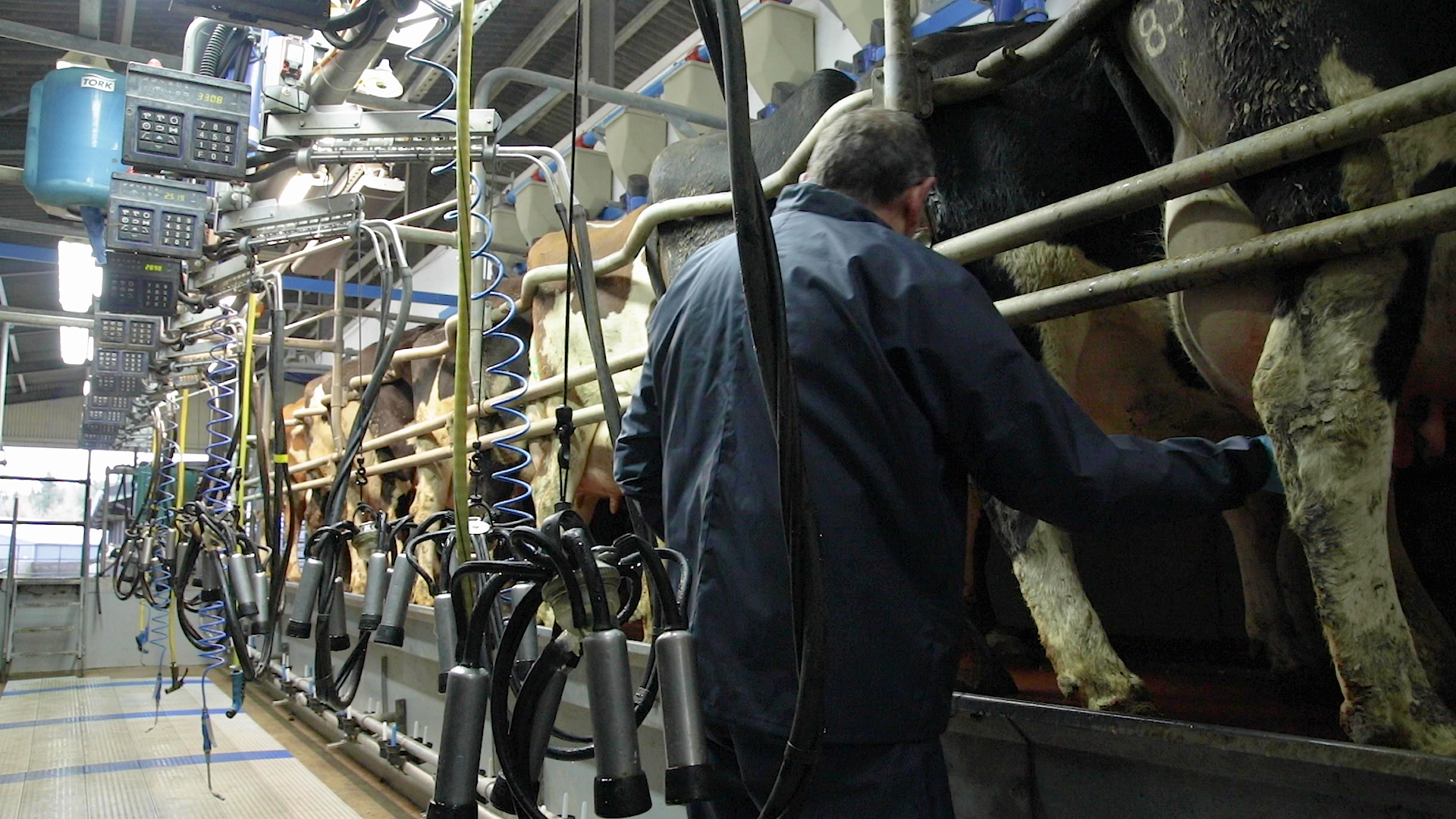
The milking process is the most important job on dairy farms, and it takes place up to 365 days/year.
Having an effective milking routine is important for a number of reasons, the number one being that you are dealing with a food product.
Most spring-calving herds now have the cows dry, with farmers and animals taking a well-earned rest.
But it won’t be long until they are back in the parlour, cupping cows.
Milking preparation
Preparation of the parlour and the milker are key parts of a successful milking routine.
In four short videos below, Padraig O’Connor from Teagasc outlines some of the key parts of a successful milking routine.
The three main objectives of a milking routine are:
- Producing high-quality milk;
- Being efficient in the pit;
- And to have the process as stress-free as possible for milker and cows.
Start by ensuring that all the gates are closed properly and that the milking parlour is ready to start.
Wet down the area so it is easier to clean and keep clean during milking.
O’Connor said: “The milker is a conduit between the milking machine and the cow.
“[So] it is important the milker remains clean before, during and after milking.”
O’Connor recommends that farmers wear a clean parlour apron or suit and nitrite disposable gloves.
Cluster attachment
When attaching cluster to cows it is important that they are attached to clean, dry teats.
For the left-hand side, hold the cluster in your right hand or the cluster closest to the front of the pit and attach the cups with your left hand.
When attaching the cups to cows, O’Connor recommends starting with the back-right cup and working in an anti-clockwise direction.
This means attaching the back right, followed by the front right, followed by the front left and lastly the back-left cluster.
Once the cluster has been attached it is important to check that it is sitting squarely on the cow.
This will cut down on liner slip and ensure that the cow is milked correctly.
Continue com as notícias que estão puxando a atenção dos leitores
Cluster removal
Although many farmers have automatic cluster removers (ACRs), a large number of parlours still do not and knowing how to remove a cluster properly and efficiently is important.
O’Connor said that when removing clusters from the left-hand side of the parlour you should catch the cluster with your left hand.
For the right-hand side of the parlour the hand is then changed to the right hand.
This means when you remove the cluster from the cow that you are correctly positioned and easily able to move to the next cow in the row.
Post-milking disinfectant
It is important that the teat disinfectant is applied straight after the cluster has been removed from the cow, before the sphincter canal starts to close.
Applying the disinfectant straight away reduces the amount of time bacteria has to enter the teat opening.
Spraying should be done before cows move off and are directed upwards, with the whole area of the teat being covered.
About 10ml/cow should be used for a dip and 15ml/cow for a spray.
Advice
Many farmers have different opinions on where the best place to start cupping cows may be.
O’Connor recommends farmers start cupping from the front of the parlour.
He said: “In a bigger parlour, once the first four or five cows are in place you can start preparing and cupping, while other cows are still filtering into the parlour.
“The second reason is when you are three quarters of the way back you can release the row you are taking the clusters off.”
❓ Perguntas Frequentes (5 FAQs Técnicos de Campo)
📌 1. Qual a importância de Improving the effectiveness of your milking routine para o produtor rural?
Garante a otimização de custos, o aumento da produtividade por hectare e o cumprimento das normas sanitárias e ambientais vigentes.
📌 2. Como as recomendações da Embrapa auxiliam em Improving the effectiveness of your milking routine?
A Embrapa fornece dados validados de pesquisa de campo, reduzindo os riscos operacionais e melhorando a eficiência do uso de insumos.
📌 3. Qual a relação entre Improving the effectiveness of your milking routine e o crédito no Plano Safra?
Propriedades com processos regulares e CAR ativo possuem pontuação preferencial na concessão de financiamentos agrícolas com juros reduzidos.
📌 4. Como calcular o retorno financeiro em Improving the effectiveness of your milking routine?
O retorno é medido pelo acompanhamento do Custo Operacional Efetivo (COE) e pelo ganho de produtividade obtido a cada ciclo de produção.
📌 5. Quais as tendências de inovação para Improving the effectiveness of your milking routine em 2026?
Destacam-se a automação por sensores, o uso de inteligência artificial preditiva e o monitoramento em tempo real por imagens de satélite.


