
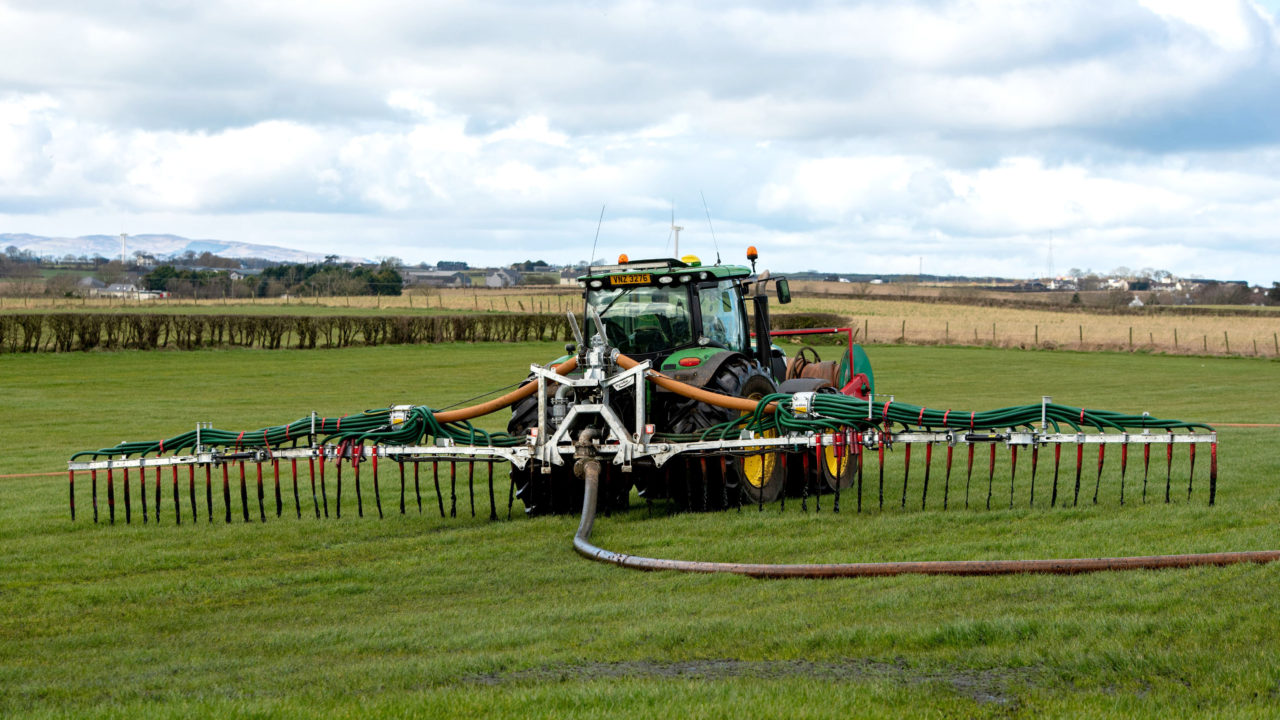

From late next week onwards, farmers in 11 counties across Ireland will be permitted to spread slurry on their land.
Open and closed slurry and fertiliser spreading periods are often an area that can cause confusion among farmers and potentially adding to this, this year, are changes to the dates for the closed slurry-spreading period.
A statement from the Department of Agriculture, Food and the Marine (DAFM) has outlined: “In 2023, the permitted period for the application of organic fertilisers ceases on September 30, for Zone A, B and C.
The table below outlines the permitted spreading dates for organic fertilisers (including slurry) and farmyard manures in 2023:
| Zone | Organic fertilisers (excluding FYM) | Farmyard manure (FYM) |
|---|---|---|
| Zone A: | January 13 to September 30 | January 13 to October 30 |
| Zone B: | January 16 to September 30 | January 16 to October 30 |
| Zone C: | February 1 to September 30 | February 1 to October 30 |
The following list is a breakdown if the counties in each zone:
- Zone A: Carlow, Cork, Dublin, Kildare, Kilkenny, Laois, Offaly, Tipperary, Waterford, Wexford, Wicklow;
- Zone B: Clare, Galway, Kerry, Limerick, Longford, Louth, Mayo, Meath, Roscommon, Sligo, Westmeath;
- Zone C: Cavan, Monaghan, Donegal, Leitrim.
However, pre-defined criteria for the application of slurry up to October 15, has been made available by the DAFM (see below).
Where these criteria are met, farmers may be eligible to spread slurry up to October 15, of that year, according to the DAFM.
Exemption criteria closed period
The Good Agricultural Practice Regulations outline the exemption criteria for the closed period and shallow cultivation.
According to the regulation, to reduce the closed period for slurry spreading from October 1, in 2023, the following scientific criteria should apply:
Continue com as notícias que estão puxando a atenção dos leitores
- Exceptional weather conditions leading up to the closed period must be
- demonstrated;
- The Moore Park St. Jilles Grass Growth Model (MoST) must demonstrate sufficient growth for nutrient uptake;
- No heavy rain forecast;
- Consideration may also be given to the situation pertaining on farms.
To reduce the closed period for chemical fertiliser application to January 15, in Zone A and B, and January 31, in Zone C, the following scientific criteria should apply:
- The Moore Park St. Jilles Grass Growth Model (MoST) must demonstrate sufficient growth for nutrient uptake;
- No heavy rain forecast.
To exempt tillage land from shallow cultivation within 14 days post-harvest the following criteria must apply:
- Saturated soil conditions as per Met Eireann’s Soil Moisture Deficit Model;
- Drought conditions as per Met Eireann’s Soil Moisture Deficit Model;
- Consideration of the weather forecast issued by Met Eireann, potentially including forecasted heavy rainfall event(s).
The scientific criteria mentioned for the exemptions are based on recommendations from the nitrates expert group.
❓ Perguntas Frequentes (5 FAQs Técnicos de Campo)
📌 1. Qual a importância de Changes made to permitted spreading dates para o produtor rural?
Garante a otimização de custos, o aumento da produtividade por hectare e o cumprimento das normas sanitárias e ambientais vigentes.
📌 2. Como as recomendações da Embrapa auxiliam em Changes made to permitted spreading dates?
A Embrapa fornece dados validados de pesquisa de campo, reduzindo os riscos operacionais e melhorando a eficiência do uso de insumos.
📌 3. Qual a relação entre Changes made to permitted spreading dates e o crédito no Plano Safra?
Propriedades com processos regulares e CAR ativo possuem pontuação preferencial na concessão de financiamentos agrícolas com juros reduzidos.
📌 4. Como calcular o retorno financeiro em Changes made to permitted spreading dates?
O retorno é medido pelo acompanhamento do Custo Operacional Efetivo (COE) e pelo ganho de produtividade obtido a cada ciclo de produção.
📌 5. Quais as tendências de inovação para Changes made to permitted spreading dates em 2026?
Destacam-se a automação por sensores, o uso de inteligência artificial preditiva e o monitoramento em tempo real por imagens de satélite.


